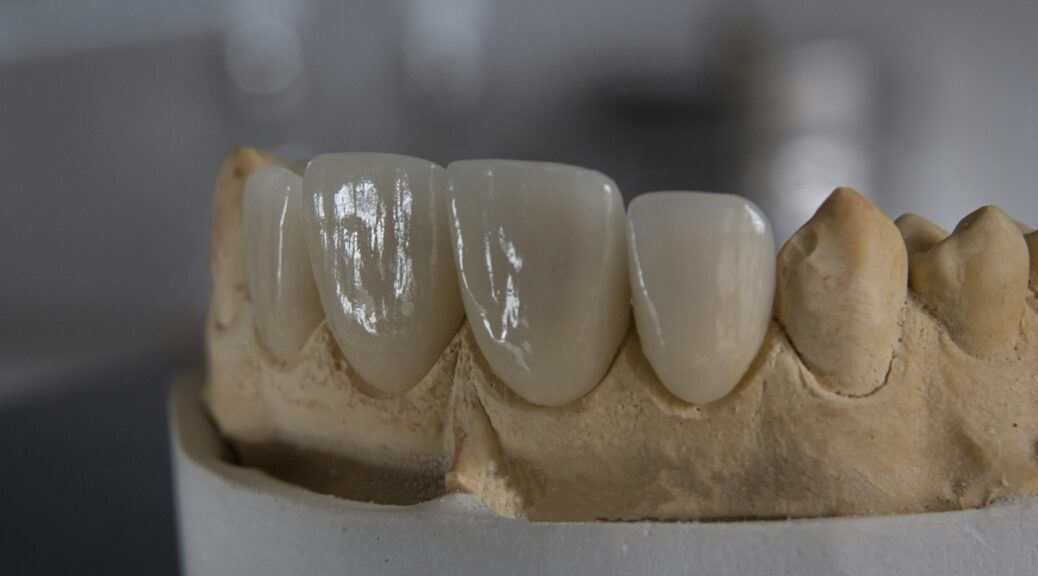
Crowns, bridges or dentures: which tooth restoration is right for you in Switzerland?
In short: a crown protects and rebuilds a damaged tooth, a bridge replaces a missing tooth by anchoring on its neighbours, and a removable denture replaces several or all teeth when fixed options are not possible or not wanted. Each has a role: the best choice depends on the condition of the remaining teeth, the gums and the bone, your bite, your budget and how much healthy tooth structure you are willing to sacrifice. Long-term studies show that well-made crowns and conventional bridges in metal-ceramic, lithium disilicate or zirconia survive five years in roughly nine cases out of ten or more, while dentures need regular relining and replacement. In Switzerland, these treatments are almost always self-funded, since basic insurance (KVG/LAMal) only pays for dental care in narrow cases such as severe unavoidable diseases or accidents. This guide explains materials, techniques, lifespans, costs structure and how to decide, tooth by tooth.
This article is general information. It does not replace an examination or advice from a qualified dentist.
For implants specifically, see our guide to single implants, implant bridges and All-on-4; for cosmetic work on front teeth, see veneers, whitening and aligners. This article covers the restorations that rebuild function: crowns, conventional and adhesive bridges, partial and complete dentures.
Contents
- What is new in 2025 and 2026
- Crown, bridge, denture or implant: the basics
- Crowns: when a tooth really needs one
- Ceramic, zirconia or metal-ceramic?
- Bridges: conventional, cantilever and Maryland
- Removable partial dentures and the cobalt-chromium frame
- Complete dentures and implant-retained dentures
- When to choose what
- How treatment works, appointment by appointment
- Costs and insurance in Switzerland
- Living with crowns, bridges and dentures
- Switzerland or abroad: what really changes
- FAQ
What is new in 2025 and 2026
Ticino rejects compulsory dental insurance
On 14 June 2026, 70.16% of Ticino voters rejected a proposal for compulsory dental insurance. In a press release dated 15 June 2026, the Swiss Dental Association (SSO) welcomed the result and recalled that similar proposals had previously failed in Vaud, Geneva and Neuchâtel. For residents of Switzerland, this confirms the status quo: crowns, bridges and dentures remain largely self-funded, unless a supplementary dental policy contributes, within its limits, or one of the narrow exceptions of basic insurance applies. Planning, comparing estimates and choosing durable solutions therefore remain essential.
Mercury fillings banned in the European Union
Since 1 January 2025, Regulation (EU) 2024/1849 bans dental amalgam in the European Union, apart from strictly justified exceptions. Switzerland is not bound by EU law, and amalgam was already rarely placed by Swiss dentists. The relevance for this guide is indirect: many older patients have large amalgam fillings in molars, and when these fail, the question of a crown or a partial crown often follows. There is no general recommendation to remove intact amalgam fillings.
Digital workflows are now routine
Intraoral scanners, computer-aided design and milling machines (CAD/CAM) have become routine in many Swiss practices and laboratories. They allow crowns in ceramic or zirconia to be designed on screen and milled, sometimes on the same day. The technology changes the process more than the result: the fit, the choice of material and the dentist’s skill remain what matter.
| Date | Development | What it means for you |
|---|---|---|
| 1 Jan. 2025 | EU amalgam ban (Regulation 2024/1849) | Old amalgam fillings are replaced when they fail, often by ceramic onlays or crowns |
| 14-15 June 2026 | Ticino rejects compulsory dental insurance (SSO release) | Crowns, bridges and dentures remain largely self-funded |
| Ongoing | Digital scanning and CAD/CAM | Fewer impressions, sometimes same-day crowns; quality depends on planning and skill |
Crown, bridge, denture or implant: the basics
What is the difference between a crown and a bridge?
A crown is a cap that covers a single damaged tooth, rebuilding its shape and protecting it. A bridge replaces one or more missing teeth: the false tooth (called a pontic) is attached to crowns placed on the teeth on either side (the abutments), or, in some designs, to one side only, or bonded to the back of the neighbouring teeth. Both are fixed: you cannot remove them yourself.
What is a removable denture?
A denture is an appliance that you take out to clean. A partial denture replaces some teeth and is held by clasps or attachments on your remaining teeth. A complete denture replaces all the teeth of an arch and rests on the gums, held by suction and muscle control, or by implants.
Where do implants fit in?
An implant replaces the root of a missing tooth and can carry a single crown, a bridge or a denture. It avoids touching neighbouring teeth but requires surgery, sufficient bone and time. Implants are discussed in our dedicated implant guide; here we compare them only where the choice matters.
| Option | Replaces | Fixed or removable | Main advantage | Main drawback |
|---|---|---|---|---|
| Crown | Damaged tooth | Fixed | Protects a weakened tooth and restores chewing | Removes a lot of tooth structure |
| Conventional bridge | 1 to 2 missing teeth (sometimes more) | Fixed | No surgery; quick; long track record | Neighbouring teeth are ground down |
| Adhesive (Maryland) bridge | Usually 1 front tooth | Fixed | Minimal preparation of neighbouring teeth | Limited indications; may come unstuck |
| Partial denture | Several missing teeth | Removable | Few interventions on teeth; adaptable | Less comfortable; plaque around clasps |
| Complete denture | All teeth of an arch | Removable | Accessible, non-surgical | Stability, especially in the lower jaw |
| Implant with crown | 1 missing tooth | Fixed | Does not touch neighbouring teeth; preserves bone | Surgery, time, bone requirements |
Crowns: when a tooth really needs one
A crown is a powerful tool for saving a weakened tooth, and an unnecessary sacrifice when used on a healthy one. The decision starts with the tooth, not with the material.
When does a tooth need a crown?
- A molar or premolar that has had root canal treatment and has lost much of its structure, to reduce the risk of fracture.
- A tooth with a very large filling or a filling that keeps failing.
- A cracked tooth, to hold the parts together, if the crack does not reach the root.
- A broken or severely worn tooth, for example after years of grinding.
- A tooth that supports a bridge or a partial denture.
- A front tooth that is heavily filled or discoloured, when a veneer is not enough.
How much tooth is removed for a crown?
Much more than most people imagine. A laboratory study by Edelhoff and Sorensen, published in 2002 in the Journal of Prosthetic Dentistry, measured the tooth structure removed by different preparations: about 63% to 72% of the visible part of the tooth for all-ceramic and metal-ceramic crowns, against about 3% to 30% for veneers and the retainers of adhesive bridges. That is why a crown on a healthy tooth, for purely cosmetic reasons, is rarely justified, and why « Turkey teeth », crowns placed on rows of healthy teeth, have caused so much concern.
Is there something between a filling and a crown?
Yes. An inlay or onlay (also called a partial crown) is a ceramic or composite piece made in the laboratory or milled, bonded into or onto the tooth, which covers only the damaged parts and the cusps at risk. When enough healthy tooth remains, it preserves far more structure than a full crown. Modern bonding techniques have made these partial restorations a standard option for back teeth.
Does a crowned tooth need root canal treatment?
Not necessarily. Many crowned teeth remain alive. But grinding a tooth for a crown is a stress for the pulp (the nerve), and some teeth that were already compromised by deep decay or large fillings develop pulp problems later. The dentist usually checks the tooth’s vitality and the X-ray before preparing it, and tells you if root canal treatment is advisable first.
What is a post and core?
When a root-treated tooth has lost most of its crown, the dentist may place a post in the root canal and build up a core, on which the crown is cemented. Posts are used when there is too little tooth left to hold the crown otherwise. The more of the natural tooth is preserved around the base (the « ferrule »), the better the long-term prognosis.
Ceramic, zirconia or metal-ceramic?
Patients often ask for « the best material ». There is no single best material, only the right material for a given tooth, bite and aesthetic demand.
What does the research say about survival?
A systematic review by Sailer, Pjetursson and colleagues, published in 2015 in Dental Materials, pooled 67 studies on more than 14,000 single crowns. The estimated five-year survival was 94.7% for metal-ceramic crowns and 96.6% for leucite- or lithium disilicate-reinforced glass ceramic crowns. Densely sintered zirconia crowns showed a survival of 92.1% at five years in that analysis, with more veneering ceramic fractures and more loss of retention than metal-ceramic crowns. Feldspathic and silica-based ceramics did less well, especially on back teeth, and the authors concluded they should be limited to front teeth.
What about monolithic zirconia?
The zirconia crowns studied in the 2015 review were mostly « veneered »: a zirconia core covered with a layer of more aesthetic porcelain, which could chip. Monolithic zirconia, milled from a single block without a porcelain layer, was developed partly to avoid this problem and is now widely used on molars. It is very strong and needs less tooth reduction than veneered crowns, but it is more opaque than glass ceramics, and long-term clinical data are shorter than for metal-ceramic crowns. Newer, more translucent zirconias trade some strength for better appearance.
| Material | Typical use | Strengths | Limits |
|---|---|---|---|
| Metal-ceramic (porcelain fused to metal) | Crowns and bridges anywhere | Longest track record; reliable for long bridges | Possible grey line at the gum; metal visible if gums recede |
| Lithium disilicate (glass ceramic) | Front teeth, premolars, partial crowns | Very natural look; can be bonded; good survival in studies | Less suited to long bridges and very heavy bites |
| Monolithic zirconia | Molars, patients who grind, bridges | Very strong; no veneer layer to chip | More opaque; shorter long-term data; hard to adjust |
| Veneered (layered) zirconia | Front and back teeth | Strong core with aesthetic surface | Risk of chipping of the porcelain layer |
| Feldspathic ceramic | Front teeth, veneers | Excellent aesthetics | Fragile; not for back teeth |
| Gold alloy | Back teeth | Very durable, gentle on opposing teeth, thin preparation | Visible metal; rarely requested today |
| Composite or resin | Temporary crowns, provisional bridges | Quick and adjustable | Wears and discolours; not a long-term solution |
Which material for a front tooth?
Usually a glass ceramic such as lithium disilicate, or a layered zirconia when the underlying tooth is very dark or a metal post must be masked. The colour must match the neighbouring teeth, which is why the shade is often chosen in daylight, before any whitening of the other teeth, since crowns do not whiten.
Which material for a molar?
Monolithic zirconia, metal-ceramic or lithium disilicate, depending on the space available, the bite and whether you grind your teeth. In people with strong bruxism, many dentists favour monolithic zirconia or metal and recommend a night guard.
Can I have a metal-free mouth?
Yes, all-ceramic and zirconia restorations avoid metal. True allergy to dental alloys is uncommon, but some patients prefer metal-free solutions for aesthetic or personal reasons. If you have a known nickel allergy, tell your dentist so that the alloy, if any, is chosen accordingly.
Bridges: conventional, cantilever and Maryland
Before implants became common, the bridge was the standard way to replace a missing tooth. It remains an excellent solution in the right situation.
How long do conventional bridges last?
A systematic review by Pjetursson and colleagues, published in 2007 in Clinical Oral Implants Research, estimated the survival of conventional tooth-supported bridges at 93.8% after five years and 89.2% after ten years. The most frequent complications of these bridges were biological: decay under the crowns of the abutment teeth and loss of the teeth’s vitality. In the 2015 Dental Materials review of bridges by material, metal-ceramic bridges had an estimated five-year survival of 94.4%, against 90.4% for densely sintered zirconia and 89.1% for reinforced glass ceramic bridges; zirconia bridges showed more chipping and loss of retention.
When is a bridge a good choice?
A bridge makes most sense when the neighbouring teeth already need crowns, for example because they have large fillings or root canal treatment: grinding them is then not a sacrifice but a benefit. It is also a good option when an implant is impossible or unwanted, for medical reasons, lack of bone, or because surgery is not an option for you. When the neighbouring teeth are intact, an implant or an adhesive bridge usually preserves more natural tooth.
What is a cantilever bridge?
A cantilever bridge is attached to one side only. It requires less preparation but puts more leverage on the supporting tooth. In the 2007 review, cantilever bridges had a survival of 91.4% at five years and 80.3% at ten years, lower than conventional bridges. They are mostly used for a small tooth, such as a lateral incisor or a premolar, when the forces are moderate.
What is a Maryland (adhesive) bridge?
A resin-bonded bridge, often called a Maryland bridge, consists of a false tooth with a thin wing bonded to the back of a neighbouring tooth, with minimal preparation. Modern versions in ceramic, bonded to a single neighbouring tooth, have shown good results for front teeth: a study by Kern and colleagues, published in 2017 in the Journal of Dentistry, reported survival of 95.4% at both ten and fifteen years for all-ceramic, single-wing adhesive bridges replacing front teeth, dropping to 81.8% after eighteen years. These bridges are a useful solution for young patients waiting for an implant, or as a long-term option when the gap is small and the bite favourable.
Bridge or implant: which is better?
| Situation | Usually favours | Why |
|---|---|---|
| Neighbouring teeth intact, good bone | Implant (or adhesive bridge for a front tooth) | Does not grind healthy teeth |
| Neighbouring teeth heavily filled or crowned | Conventional bridge | Abutments benefit from crowns anyway |
| Insufficient bone; grafting not wanted | Bridge | Avoids bone surgery |
| Medical reasons against surgery | Bridge or denture | No surgical risk |
| Young patient, missing lateral incisor | Adhesive bridge, implant later if appropriate | Minimal intervention while the face is still developing |
| Long gap, several teeth missing | Implant bridge or partial denture | A long tooth-supported bridge carries more risk |
Can a bridge be repaired if one tooth fails?
Sometimes a chipped ceramic can be polished or repaired, and a bridge that has come loose can be re-cemented if the teeth are sound. If decay develops under an abutment crown, the bridge often has to be removed and remade. That is why hygiene under and around a bridge is essential.
Comparing options for your teeth? Send your recent X-ray or 3D scan and a description of your situation for a free, personalised quote, sent within 48 hours and without commitment.
Removable partial dentures and the cobalt-chromium frame
Partial dentures have a modest image, but they remain the right answer in many situations: several gaps at once, teeth whose future is uncertain, or a need for a reversible, accessible solution.
What types of partial denture exist?
- Acrylic partial denture: a pink plastic base with teeth, held by wire clasps. Quick and accessible, often used as a temporary solution after extractions or during implant healing. It covers more of the palate or gums and is less stable.
- Cobalt-chromium (metal frame) partial denture: often called a « skeleton » or, in French-speaking Switzerland and France, a « stellite ». A thin, cast metal framework rests on the teeth and gums, with clasps and rests designed to transfer chewing forces. It is thinner, more rigid and more comfortable than acrylic, and the standard for a long-term removable solution.
- Flexible (nylon) partial denture: a pink, flexible base without visible metal clasps. Aesthetic and comfortable at first, but harder to adjust, reline or repair, and less suited to supporting the bite in the long term.
- Partial denture with attachments: invisible precision attachments link the denture to crowns on the remaining teeth. More aesthetic, more complex, and dependent on those crowned teeth.
Does a partial denture damage the remaining teeth?
It can, if hygiene is poor or the denture is badly designed. Clasps and the denture base retain plaque, which increases the risk of decay and gum disease on the supporting teeth. A well-designed metal frame that rests on the teeth, combined with careful cleaning and regular check-ups, limits this risk. Remove the denture to clean it and your teeth every day.
How long does a partial denture last?
A well-made metal-frame denture can last many years, but the gums and bone under it change over time, so it may need relining or adjustment. Teeth can be added to many partial dentures if another tooth is lost, which is one of their advantages.
Should I sleep with my denture?
Most dentists advise removing dentures at night to let the tissues rest and to reduce the risk of fungal infection under the denture (denture stomatitis), unless your dentist tells you otherwise for a specific reason. Store them clean, in a dry container or in water, according to the material.
Complete dentures and implant-retained dentures
How is a complete denture made?
The process usually takes several appointments: impressions of the gums, recording of the bite and the height of the face, choice of tooth shape and colour, a try-in with the teeth set in wax, then delivery and adjustments. Immediate dentures can be inserted on the day of extraction, so that you are never without teeth, but they need relining or replacing after the gums have healed and shrunk.
Why is a lower denture often harder to wear?
An upper denture covers the palate and holds by suction. A lower denture has a much smaller surface, and the tongue and cheeks move it. With bone loss over the years, many people struggle to keep it in place. Adhesives can help; a well-made denture and practice help more; and implants can transform stability.
What is an implant-retained denture (overdenture)?
Two or more implants are placed in the jaw, and the denture clips onto them with attachments. It remains removable for cleaning but stays firmly in place when eating and speaking. The McGill consensus statement, published in 2002, concluded that a lower denture retained by two implants should be considered the first-choice standard of care for people without teeth in the lower jaw. For the upper jaw, more implants are usually needed. Fixed full-arch solutions such as All-on-4 go further and are covered in our implant guide.
How long does it take to get used to a complete denture?
Usually several weeks. Expect extra saliva, some speech changes and sore spots at first, which the dentist relieves by adjusting the denture. Start with soft food cut into small pieces, chew on both sides at the same time, and practise reading aloud. If pain persists, return to the dentist rather than living with it.
How often should a denture be relined or replaced?
Because the bone under the gums continues to change, dentures gradually lose their fit. A check-up at least once a year is reasonable; relining is needed when the denture becomes loose, and replacement when the teeth are worn or the base is damaged, often after several years. An ill-fitting denture can cause sores and accelerate bone loss.
When to choose what
The following situations are common in Swiss practices. They do not replace an examination, but they show the logic dentists follow.
| Situation | Options usually discussed | Points to weigh |
|---|---|---|
| Molar with a large old filling that cracked | Onlay (partial crown) or crown | Onlay if enough sound tooth remains; crown if walls are weak |
| Root-treated molar | Onlay or crown, sometimes with a post | Cusp protection reduces fracture risk |
| One missing tooth, healthy neighbours | Implant; adhesive bridge for a front tooth | Bone volume, health, timing |
| One missing tooth, heavily restored neighbours | Conventional bridge or implant | The bridge also rebuilds the neighbours |
| Several missing back teeth on one side | Implants, implant bridge or partial denture | Cost, surgery, chewing comfort |
| Scattered gaps in both arches, uncertain teeth | Metal-frame partial denture | Flexible; teeth can be added later |
| No teeth in the lower jaw, loose denture | Two-implant overdenture | Major gain in stability for moderate surgery |
| Complete loss of teeth, wish for fixed teeth | Full-arch implant bridge (All-on-4 or similar) | Bone, health, budget, maintenance |
Should I save a weak tooth or extract it?
It depends on the tooth’s strategic value and its prognosis. A tooth with a vertical crack into the root, severe bone loss or decay below the bone level may not be worth a crown. A dentist who explains the prognosis of each tooth, and the consequences for the overall plan, is more useful than one who simply proposes the most extensive or the cheapest option.
Does my gum health matter before crowns and bridges?
Yes, a great deal. Crowns and bridges on teeth with untreated gum disease are built on unstable foundations. Periodontal treatment comes first, and the margins of new crowns should be designed so that you can clean them.
What if I grind my teeth?
Bruxism is one of the main causes of chipped ceramics, fractured crowns and loosened bridges. Tell your dentist if you wake up with sore jaws or if your teeth show wear. Stronger materials and a night guard made after treatment protect your investment.
How treatment works, appointment by appointment
What happens before a crown or bridge is made?
An examination, X-rays (sometimes a 3D scan if implants are being considered), treatment of decay and gum disease, and sometimes root canal treatment. The dentist then proposes a plan and a written cost estimate. Swiss dentists generally invoice according to the SSO’s tariff structure, in which each treatment has a number of points multiplied by a practice-specific point value; that is why estimates for the same plan can differ between practices.
How many appointments does a crown take?
Traditionally two: one to prepare the tooth and take an impression or scan, with a temporary crown placed the same day, and one to fit and cement the final crown, usually one to two weeks later. With chairside CAD/CAM, some ceramic crowns are made in a single, longer appointment. Bridges and more complex plans may require try-ins.
What are provisional (temporary) crowns for?
They protect the prepared tooth, keep the gum in shape, maintain the space and let you test shape and bite. A provisional is not designed to last: avoid sticky foods and floss carefully by pulling the floss out sideways. If it comes off, call the practice; do not leave a prepared tooth uncovered for long.
Will it hurt?
Preparation is done under local anaesthesia. Some sensitivity to cold in the days after preparation or cementation is common and usually fades. Persistent or spontaneous pain, especially at night, should be reported, because it may indicate that the nerve is inflamed.
What should a good estimate include?
- Each tooth concerned and the treatment proposed for it.
- The material and the laboratory, including whether the work is done locally or abroad.
- Preliminary treatments: fillings, root canals, gum treatment, extractions.
- Provisional restorations and their duration.
- The number of appointments and follow-up visits.
- What happens if a tooth turns out to need additional treatment.
Costs and insurance in Switzerland
Does basic insurance pay for crowns, bridges or dentures?
Generally not. Basic health insurance (KVG/LAMal) covers dental treatment only in narrow cases defined in the law and the health care benefits ordinance (KLV/OPAS): damage caused by a severe and unavoidable disease of the chewing system, dental treatment required by a serious general illness or its treatment, and treatment of the consequences of an accident when no accident insurer covers it. Routine crowns, bridges and dentures needed because of decay, gum disease or wear are self-funded.
And after an accident?
If you work at least eight hours a week for the same employer, accidents outside work are generally covered by the employer’s compulsory accident insurance (UVG/LAA), including damage to teeth. If you are not covered by accident insurance, for example if you are self-employed or not working, accident cover is included in your basic health insurance. Report a dental accident promptly, keep photos and the dentist’s report, and inform the insurer before major treatment starts.
Do supplementary dental policies help?
They can contribute, but they usually have annual limits, a reimbursement percentage, waiting periods and exclusions for pre-existing problems. Many insurers require a dental check-up before accepting you. Read the conditions carefully before signing, and do not count on a policy taken out shortly before a large treatment.
Why do estimates for the same treatment differ so much?
The point value varies between practices, laboratories charge differently, and materials, the number of provisionals and preliminary treatments differ. A cheaper estimate may omit steps that another includes. Compare like with like, tooth by tooth.
Living with crowns, bridges and dentures
How do I clean under a bridge?
Use floss threaders, special floss with a stiff end, interdental brushes or a water flosser to clean under the false tooth and around the abutments every day. Plaque that stays under a bridge is the main cause of decay at the margins.
How long does a crown last?
Studies report high survival at five and ten years, and many crowns last much longer. Lifespan depends on the tooth underneath, the bite, hygiene and the material. Crowns do not decay, but the tooth at their margin can.
How should I clean a denture?
Brush it daily with a soft brush and non-abrasive cleaner (ordinary toothpaste can scratch acrylic), rinse after meals, and clean your gums, tongue and remaining teeth. Hold it over a basin of water or a towel when cleaning so that it does not break if dropped. Never use boiling water.
When should I see the dentist urgently?
- A crown or bridge comes off: keep it, and see the dentist quickly so that the tooth is protected.
- Swelling, fever or throbbing pain under a crown, which can indicate infection.
- A denture sore that does not heal within two weeks, which must be examined.
- A broken denture: do not glue it yourself; repairs are usually possible.
What are the common problems after a new crown or bridge?
Most issues appear in the first weeks and are easy to fix if you report them early.
- The bite feels high: if you hit the new crown first when closing, it needs adjusting. Do not wait for it to « settle »: an overloaded tooth can become painful and the ceramic can chip.
- Sensitivity to cold: common for a few days to a few weeks after cementation. If it increases instead of fading, or if pain becomes spontaneous, the nerve may be inflamed.
- Food trapping between teeth: a contact point that is too loose lets food pack in, which irritates the gum and promotes decay. It should be corrected.
- A dark line at the gum: with older metal-ceramic crowns, gum recession can reveal the metal edge or a darker root. Replacing the crown is only worthwhile if it bothers you or if there is decay.
- Bleeding gums around the crown: often a sign of plaque at the margin, sometimes of a margin that is too bulky or too deep. Improved cleaning usually helps; if not, the dentist checks the fit.
Are some patients more at risk of failures?
Yes. People with a dry mouth, often caused by medicines or certain diseases, have a higher risk of decay at the margins of crowns and under bridges, and need extra fluoride and closer check-ups. Smokers have more gum problems around restorations. People with diabetes that is poorly controlled are more prone to gum disease, which threatens the abutment teeth. Heavy grinders break more ceramics. None of these is a reason to refuse treatment, but they influence the choice of material, the design and the follow-up rhythm.
How often should I have check-ups?
Your dentist adapts the interval to your risk, but most people with crowns, bridges or dentures benefit from a check-up and professional cleaning at least once a year, more often with gum disease, a dry mouth or many restorations. Regular X-rays allow decay under crowns to be found early, before the tooth is lost.
Switzerland or abroad: what really changes
Because crowns, bridges and dentures are mostly self-funded, many residents of Switzerland compare treatment in Switzerland with treatment abroad. The work itself can be of equal quality; the differences lie in planning, the number of trips and follow-up.
| Criterion | Switzerland | Tunisia (Medespoir) | Turkey |
|---|---|---|---|
| Price level | Reference | Around 60% below Swiss prices, according to Medespoir’s price page; exact figure on quote | The quote specifies whether the treatment is possible and where |
| Number of trips | Several visits close to home | Depends on the plan; specified in the quote | Specified in the quote |
| Language | Local language; English common in cities | Consultation and medical documents in French | Specified in the quote |
| Travel | None | Direct flights from Geneva and Basel-Mulhouse (about 2 hours); from Zurich with or without a stopover depending on the season | Several daily connections from Swiss airports |
| Follow-up | Same practice | Remote follow-up; check-ups and repairs in Switzerland at your expense | Specified in the quote |
Which treatments fit best into a trip?
Crowns and bridges on teeth that are already healthy and stable, with no gum disease or root problem pending, are the most predictable, because the work can be planned in advance from your X-rays. Complete dentures need several fittings and adjustments, and partial dentures need adjustments after you have worn them for a while, which is easier close to home. Treatment that involves extractions and bone healing usually requires more than one trip.
What should I do before leaving?
Get a recent check-up and X-ray in Switzerland, treat acute problems first, and ask for a written plan tooth by tooth. Ask which material is proposed for each tooth, how much tooth will be prepared, whether a healthy tooth will be crowned and why, and how adjustments will be handled after your return. Keep all documents, including the laboratory and material details. Medespoir’s French-language dental care guide and its page on dentistry in Tunisia describe its organisation.
What does the Tunisian package include?
For surgery, Medespoir’s Tunisian package includes the pre-operative consultation, examinations, the treatment by the full team, full-board hotel accommodation for you and one companion, all transfers and remote follow-up after your return to Switzerland. For dental treatment, the exact content of the package, the number of stays and their length are specified in your personalised quote; the price page, in French, gives the general framework. In all cases, flights, personal expenses, an extended stay for convenience, care received in Switzerland after your return, travel insurance (recommended) and bank charges remain at your expense.
How do I avoid « Turkey teeth »?
The problem is not a country but a practice: crowns on rows of healthy teeth, ground down to small stumps, often in a hurry. Ask whether veneers, onlays or orthodontics would work instead, refuse full crowns on healthy teeth for cosmetic reasons alone, and insist on a plan that preserves as much natural tooth as possible, wherever you are treated.
FAQ
Which crown material lasts longest?
Metal-ceramic and lithium disilicate crowns both showed high survival at five years in a large 2015 review. Monolithic zirconia is very strong for molars, with shorter long-term data. The right choice depends on the tooth.
Is a bridge better than an implant?
Not in general. A bridge is preferable when the neighbouring teeth need crowns anyway or when an implant is not possible; an implant is preferable when the neighbours are healthy.
How long does a dental bridge last?
A systematic review estimated survival of conventional bridges at about 94% after five years and 89% after ten years. Many last longer with good hygiene.
What is a stellite?
A removable partial denture with a thin cast cobalt-chromium frame, also called a skeleton denture. It is more rigid and comfortable than an acrylic denture.
Can I eat normally with a complete denture?
After a period of adaptation, most people eat most foods, cut into small pieces. Lower dentures are often less stable; implants can help.
Does Swiss basic insurance pay for crowns?
Only in narrow cases defined by law, such as severe unavoidable diseases or the consequences of an accident not covered by accident insurance. Routine crowns are self-funded.
Can a healthy tooth be crowned for appearance?
Technically yes, but it removes a large part of the tooth. Veneers, bonding or orthodontics are usually preferable.
How many appointments does a crown need?
Usually two, one to two weeks apart; some ceramic crowns can be made in one visit with CAD/CAM.
Your next step: request a free, personalised quote for crowns, bridges or dentures, sent within 48 hours. Medespoir’s Tunisian prices are around 60% below Swiss levels, and the plan is set tooth by tooth after reviewing your X-rays.
Main sources: Sailer I et al., all-ceramic or metal-ceramic tooth-supported single crowns, Dental Materials (2015); Sailer I et al., all-ceramic or metal-ceramic fixed dental prostheses, Dental Materials (2015); Pjetursson BE et al., survival of tooth- and implant-supported reconstructions, Clinical Oral Implants Research (2007); Kern M et al., fifteen-year survival of anterior all-ceramic cantilever resin-bonded bridges, Journal of Dentistry (2017); Edelhoff D, Sorensen JA, tooth structure removal, Journal of Prosthetic Dentistry (2002); The McGill consensus statement on overdentures, Gerodontology (2002); Regulation (EU) 2024/1849 on mercury; Federal Health Insurance Act (KVG/LAMal), Art. 31; Swiss Dental Association (SSO); Medespoir, prices.