Dental implants, veneers and whitening in Tunisia: what should you know in 2026?
In short: Dental implants, veneers, « Hollywood smile » makeovers and whitening are among the treatments Swiss residents most often look for abroad, because Swiss basic insurance almost never pays for them and Swiss dental fees are among the highest in Europe. In Tunisia, Medespoir’s dental treatment costs roughly 60% less than in Switzerland, with the treatment plan, report and implant passport provided in French. The 2025 and 2026 news is mostly about safety and traceability: the European ban on dental amalgam from 1 January 2025, mandatory registration of medical devices such as implants in Switzerland from 1 July 2026, and a growing backlash against makeovers that crown healthy teeth. This guide answers the questions people ask before committing, including the ones that matter once you are back with your Swiss dentist.
This article is general information and does not replace a dental or medical opinion. Only an examination with X-rays or a 3D scan can confirm which treatment suits you.
Contents
- What is new in cosmetic and implant dentistry in 2025 and 2026?
- Does Swiss insurance pay for dental work?
- Dental implants: the questions to ask
- All-on-4, All-on-6 and full-arch treatment
- Veneers: porcelain, composite and how much tooth is removed
- Hollywood smile: veneers, crowns and the « Turkey teeth » problem
- Teeth whitening: safe, effective, lasting?
- Three typical situations, and how they are usually planned
- What Tunisia changes: trips, time and cost
- Back home: your Swiss dentist and long-term care
- Sources
- Frequently asked questions
What is new in cosmetic and implant dentistry in 2025 and 2026?
Is amalgam now banned?
In the European Union, yes, with narrow exceptions. The revised EU Mercury Regulation (Regulation (EU) 2024/1849) phases out the use of dental amalgam from 1 January 2025 and bans its export. Member states that needed more time could keep using it until 30 June 2026, and amalgam remains allowed only where a practitioner considers it strictly necessary for a specific medical need. Switzerland is not bound by EU law, and Swiss dentists had already largely moved to composite fillings. For patients, the practical consequence is simple: if you have old amalgam fillings and are planning veneers or crowns, the dentist will discuss whether to replace them, and that should be part of the treatment plan, not a surprise on the day.
Why does medical device registration matter for implants?
Dental implants are medical devices. Since 1 July 2026, manufacturers and their authorised representatives must register medical devices in Switzerland’s swissdamed database run by Swissmedic. That does not change what a Tunisian dentist may use, but it reinforces a principle that matters for any implant placed abroad: you must know exactly which system was used, with the brand, model, diameter and length. Without that information, a Swiss dentist may struggle to find compatible parts to repair or replace a crown in ten years. Medespoir provides an implant passport in French for this reason.
Is the trend for « Hollywood smiles » changing?
It is being questioned. After several years in which social media made very white, very even smiles fashionable, dentists in Europe and the UK have reported many patients who had healthy teeth cut down for full crowns abroad, then developed sensitivity, nerve damage or gum problems. The current direction among cosmetic dentists is minimal intervention: whitening first, then composite or thin ceramic veneers on the teeth that need them, and crowns only for teeth that are already damaged. Our French article on « Turkey teeth »: why to be wary of crowns placed on healthy teeth covers that issue in detail; below we focus on how to plan a sensible treatment in Tunisia.
| Date | What changed | Why it matters to you |
|---|---|---|
| 1 January 2025 | EU phase-out of dental amalgam (Regulation 2024/1849) | Old amalgam fillings are replaced with composite or ceramic; discuss it in the treatment plan |
| 30 June 2026 | End of the temporary EU derogation for amalgam | Amalgam is now exceptional across the EU |
| 1 July 2026 | Mandatory registration of medical devices in Switzerland’s swissdamed database | Traceability of implants; keep your implant passport |
| 2025 to 2026 | Professional criticism of full-crown makeovers on healthy teeth | Ask for the least invasive option that achieves your goal |
Does Swiss insurance pay for dental work?
Does basic insurance (KVG/LAMal) cover dental implants or veneers?
Almost never. Swiss basic insurance pays for dental treatment only in specific situations defined by law: when it is caused by a severe and unavoidable disease of the chewing system, by a severe general illness or its after-effects, or when it is necessary to treat a severe general illness, plus accidents for people not covered by accident insurance. Implants to replace a tooth lost to decay or gum disease, veneers, crowns for aesthetic reasons and whitening are paid by you. Employees who lose a tooth in an accident are covered by their accident insurance (UVG/LAA), which has its own rules; tell your employer and insurer before any treatment.
What about supplementary dental insurance?
Supplementary dental policies exist, but they usually pay a percentage of the bill up to an annual cap, often have a waiting period, and exclude problems present before you signed up. Some pay for treatment abroad, others do not. If you have one, ask your insurer in writing whether it covers treatment in Tunisia, which documents it needs (an itemised invoice, X-rays, a treatment plan), and whether it needs the plan before treatment starts. Medespoir provides the quote, report and implant passport in French, which helps with these formalities.
Is it worth travelling for dental work?
For a single filling or a check-up, no. For large treatments, such as several implants, a set of veneers or a full-arch restoration, the difference in cost can be substantial: dental treatment in Tunisia with Medespoir costs roughly 60% less than in Switzerland. The question is not only price, but whether the treatment can be done safely in the number of trips you can make, and how it will be maintained afterwards in Switzerland. The rest of this guide is about that.
Dental implants: the questions to ask
What exactly is a dental implant?
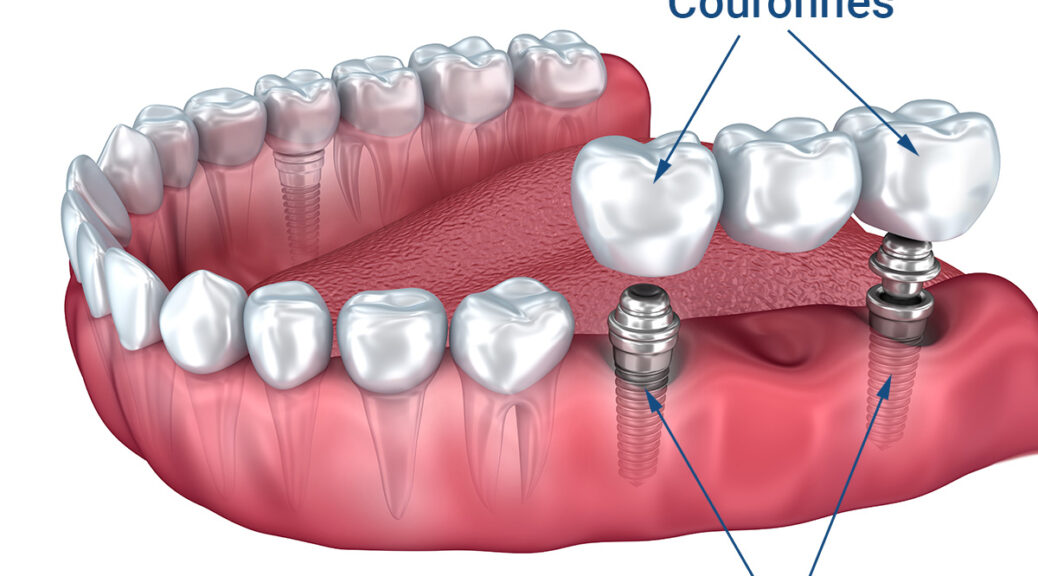
An implant is an artificial root, usually a titanium screw, placed in the jawbone. Once the bone has grown around it, a process called osseointegration, a connecting piece called an abutment is attached, and a crown, bridge or full prosthesis is fixed on top. An implant does not require grinding the neighbouring teeth, unlike a traditional bridge, which is its main advantage. The types of dental implants page (in French) explains the options in detail.
Am I a candidate for implants?
Most adults are, once growth is complete. What matters is the quantity and quality of bone, the health of the gums and your general health. Uncontrolled diabetes, heavy smoking, untreated gum disease, some bone medicines (such as bisphosphonates taken for osteoporosis or cancer) and radiotherapy to the jaw all increase the risk of failure and must be disclosed. None of these automatically rules you out, but they change the plan. A 3D scan (cone-beam CT) is the standard way to measure the bone before placing implants; ask whether it is included.
How many trips will I need for implants?
Usually two, sometimes one. In the classic protocol, the implant is placed during the first stay, the bone is left to heal for several months (often three to six, depending on the jaw and bone quality), and the final crown is fitted during a second stay. In the meantime you wear a temporary tooth if the gap is visible. When the bone is good and the implant is very stable on the day of placement, immediate loading is possible: a provisional crown or bridge is attached within days, and the final one is placed later. If you need a bone graft or a sinus lift, the timeline can be longer. Ask for a written calendar before you book flights.
Does implant surgery hurt?
Placing a single implant under local anaesthetic is usually less unpleasant than people fear, often compared to a tooth extraction. Expect some swelling and discomfort for two to four days, controlled with standard painkillers and cold packs. Several implants or bone grafting in the same session cause more swelling and sometimes bruising. Sedation may be offered for long sessions. Eat soft food for the first days and avoid chewing on the implant site until the dentist allows it.
Titanium or zirconia?
Titanium is the reference, with decades of clinical data and excellent integration. Zirconia implants are white ceramic; they interest patients with very thin gums, where a grey shadow could show, or those who want a metal-free option. Their clinical track record is shorter, and they are less versatile for complex restorations. For most patients, titanium remains the default; zirconia is a choice to make with the dentist for specific reasons.
What if I do not have enough bone?
Bone loss happens after a tooth has been missing for a while, or because of gum disease. It does not necessarily rule out implants. A bone graft, a filling of the socket after extraction, or a sinus lift in the upper back jaw can rebuild the support, sometimes in a separate step before the implant. These procedures add healing time and cost, so they must be in the quote. A dentist who announces implants without having seen a 3D scan cannot know whether you need them.
How long do implants last?
A well-integrated implant can last for decades, but the crown on top wears and may need replacing after ten to fifteen years. The main long-term threat is peri-implantitis, an inflammation of the gum and bone around the implant, similar to gum disease around natural teeth. Smokers, people with poor oral hygiene and those with a history of gum disease are at higher risk. Regular cleaning, interdental brushes and check-ups with a dentist or hygienist in Switzerland are the best protection.
What are the risks of implant surgery?
The most common problems are temporary: swelling, bruising, discomfort and minor bleeding. Less often, an implant does not integrate with the bone and has to be removed; after healing, a new attempt is usually possible. Rarer complications include damage to the nerve that runs through the lower jaw, which can cause numbness of the lip or chin, and perforation of the sinus in the upper jaw. Careful planning on a 3D scan, sometimes with a custom surgical guide, reduces these risks by showing exactly where the nerve and sinus are. Ask whether a guide will be used for your case and how a failed implant would be handled.
Can an implant be placed the same day a tooth is extracted?
Sometimes. Immediate implant placement after extraction is possible when the tooth socket is free of active infection and there is enough bone to hold the implant firmly. It shortens the overall treatment and can preserve the gum shape at the front of the mouth. When the tooth is infected, or the bone around it is damaged, the dentist will extract, let the site heal or graft it, and place the implant later. This decision is made on the scan and, finally, during the extraction itself, so the calendar can change.
Am I too old for implants?
Age itself is rarely the limit. Many patients in their seventies and eighties have implants, often to stabilise a denture that moves when they eat. What matters more is general health, medication, the ability to clean the implants and the time available for healing. For older patients who find long sessions tiring, a simpler plan, such as two implants for an overdenture, may be wiser than a complex fixed bridge.
Can I fly after implant surgery?
Generally yes, a day or two after a simple placement, once the dentist has checked the site. After a sinus lift, flying and blowing your nose are restricted for some days because pressure changes can disturb the graft; follow the dentist’s instructions exactly. A two-hour flight from Tunis is a short return, which helps.
All-on-4, All-on-6 and full-arch treatment
What is All-on-4?
All-on-4 is a technique for replacing all the teeth of one jaw with a fixed bridge supported by four implants, the two rear ones placed at an angle to avoid the sinus or the nerve and to make the most of the available bone. All-on-6 uses six implants, which spreads the chewing load and gives more security if one implant fails. Both are often loaded immediately with a provisional bridge, so you leave with fixed teeth, and the final bridge is placed after healing. It is a major treatment for people who have lost most of their teeth or whose remaining teeth cannot be saved.
Is a fixed bridge better than a removable denture on implants?
A fixed bridge feels closer to natural teeth and does not move, but it is harder to clean underneath and needs professional maintenance. A removable overdenture clipped onto two to four implants is more affordable, easier to clean and much more stable than a conventional denture. The right choice depends on your bone, your budget, your dexterity and how you feel about taking teeth out at night.
| Situation | Usual option | Typical number of trips |
|---|---|---|
| One missing tooth | Single implant and crown | Two (placement, then crown); sometimes one with immediate loading |
| Several missing teeth side by side | Implant-supported bridge | Two |
| All teeth missing or condemned in one jaw | All-on-4 or All-on-6 fixed bridge | Two: provisional bridge, then final bridge after healing |
| Unstable removable denture | Overdenture on 2 to 4 implants | One or two |
| Insufficient bone | Bone graft or sinus lift before or with implants | Two or more |
Want a treatment plan with a realistic calendar? Send your recent X-rays or a panoramic image to Medespoir if you have them, with photos of your smile. You receive a free, personalised quote within 48 hours, including the number of stays needed. Request your free quote.
Veneers: porcelain, composite and how much tooth is removed
What are veneers, and what can they fix?
A veneer is a thin shell of ceramic or composite bonded to the front of a tooth. It changes the colour, shape, length or slight misalignment of the teeth you see when you smile. It does not wrap the whole tooth, unlike a crown. Veneers suit teeth that are discoloured despite whitening, chipped, worn, small, slightly crooked or with gaps. They do not fix a bad bite, severe crowding or gum disease, which need other treatments first.
Porcelain or composite?
Ceramic veneers, such as lithium disilicate (widely known by the brand name E.max) or hand-layered feldspathic ceramic, are made in a laboratory, resist staining and can last fifteen years or more with good care. Composite veneers are resin sculpted directly on the tooth or made in a lab; they can be done in one session, often with little or no drilling, and are easier to repair, but they stain and wear faster and usually need polishing or replacing within five to seven years. The veneers page (in French) compares the materials. In Tunisia, Medespoir’s dental laboratory is on site, and the ceramist meets you at the try-in to adjust the shade in daylight.
Do my teeth have to be filed down?
It depends on the case. « No-prep » or minimal-prep veneers require little or no removal of enamel, which keeps the treatment partly reversible, but they only work when the teeth are small or set back, otherwise they look bulky. Conventional ceramic veneers usually need about half a millimetre of enamel removed from the front surface. What should worry you is a plan that removes much more than that, or turns healthy teeth into stumps for crowns. Ask how much will be removed, on which teeth, and why.
How many veneers do I need?
Most people show between eight and ten upper teeth when they smile broadly, and some show twelve. A natural result often involves treating the teeth that are visible, sometimes only the front six, and whitening the rest so that the colours match. Veneers do not change colour with whitening, so if you want whiter teeth overall, whiten first, then match the veneers to the new shade. The number is decided after examination, photos and a « smile design » mock-up; it should not be fixed in advance by a package.
How long does it take to get veneers in Tunisia?
Ceramic veneers generally take several days: examination and any preliminary treatment, preparation and digital impression, temporary veneers, try-in, then final bonding. The stay must allow the laboratory time between appointments. Composite veneers can be done faster. Some extensive projects are split into two stays, which Medespoir states from the outset. Your quote gives the length of stay for your case.
Do veneers hurt or cause sensitivity?
Preparation is done under local anaesthetic. Some sensitivity to cold in the following days is common, especially with temporaries, and usually settles once the final veneers are bonded. Persistent pain or sensitivity weeks later is not normal and should be checked, as it can be a sign of an inflamed nerve.
Can veneers be removed later?
Composite veneers placed without drilling can be removed, and the tooth underneath is largely intact. Ceramic veneers placed after enamel preparation are a permanent commitment: if you remove them, the prepared teeth will need new veneers or another restoration, because the enamel that was removed does not grow back. Think of conventional veneers as a choice for life, with replacements every fifteen years or so. That is why it is worth trying a mock-up in your mouth before preparation, to see the shape and length you are choosing.
Are there alternatives to veneers?
Often, yes, and a good dentist will mention them. Crooked teeth can be straightened with clear aligners or braces, which keeps the natural enamel intact; aligners take months and need follow-up, so they are usually done in Switzerland. Small chips and gaps can be closed with composite bonding in a single session. Discolouration can often be improved with whitening alone. Some patients combine these: aligners at home, then whitening and a few veneers in Tunisia. The least invasive option that reaches your goal is usually the best.
Hollywood smile: veneers, crowns and the « Turkey teeth » problem
What is a Hollywood smile, exactly?
It is not a dental term but a marketing one, describing a complete smile makeover with very white, regular, symmetrical teeth. It can be achieved with veneers, crowns, whitening, gum reshaping or a combination. The question is not whether you want a « Hollywood smile » but which teeth need which treatment. The Hollywood smile page (in French) describes Medespoir’s approach.
Veneers or crowns: what is the difference for my teeth?
A veneer covers the front of the tooth; a crown covers all of it, which requires removing much more tooth structure, often between one and two millimetres all round. Crowns are appropriate for teeth that are already heavily filled, broken or root-treated. Placed on healthy teeth for aesthetic reasons, they can irritate or kill the nerve, leading to root canal treatment, and they shorten the life of the tooth. This is the core of the « Turkey teeth » controversy: not the country, but the choice to crown healthy teeth to save time.
How white should I go?
Very white shades that look striking in photos can look artificial in daylight and against your skin and the whites of your eyes. Most cosmetic dentists recommend a shade one or two steps lighter than your whitened natural teeth, chosen in natural light. Medespoir’s ceramist chooses the shade with you in daylight. Look at your face, not only at your teeth, when you decide.
Does gum shape matter?
Yes, a lot. Uneven gum lines or a « gummy smile » can make even perfect veneers look wrong. Gum reshaping (gingivectomy or gingivoplasty) adjusts the gum line before veneers are placed. It is a small procedure but it adds healing time. See the gingivectomy page (in French). Gum disease must be treated before any cosmetic work; bonding veneers on inflamed gums leads to bleeding, recession and failures.
Teeth whitening: safe, effective, lasting?
Is professional whitening safe?
When done or supervised by a dentist, yes. Whitening uses peroxide gels that penetrate the enamel and break down stains. The usual side effects are temporary sensitivity and gum irritation, which settle within days. In the European Union, products releasing higher concentrations of hydrogen peroxide are reserved for dental professionals, with the first treatment carried out or supervised by a dentist and use restricted for minors. Be wary of strong whitening products bought online or applied in beauty salons, and of « whitening » with acidic or abrasive home remedies, which damage enamel.
How long does whitening last?
Usually one to three years, depending on what you eat and drink and whether you smoke. Coffee, tea, red wine and tobacco bring stains back faster. Touch-ups with custom trays at home, prescribed by a dentist, keep the shade. Whitening does not change the colour of existing crowns, veneers or fillings, which is why it should be done before any cosmetic restorations. The teeth whitening page (in French) describes the methods.
Can whitening damage my enamel?
Professional peroxide whitening used as directed does not dissolve enamel, which is what distinguishes it from acidic home remedies such as lemon juice, vinegar or abrasive charcoal powders, which can wear it away for good. Over-use is another matter: whitening every few weeks, or leaving trays in much longer than prescribed, increases sensitivity and can irritate the gums. People with receding gums, exposed roots, cracks or untreated cavities should have those problems looked at first, because the gel can reach the nerve through them and cause sharp pain. Whitening is also not recommended during pregnancy or breastfeeding, simply because there are few data, and the treatment can wait. Finally, very dark grey or brown discolouration caused by old antibiotics, trauma or a dead nerve responds poorly to external whitening; internal whitening of a root-treated tooth or a veneer may then be the better answer.
Laser whitening, LED, trays: which works best?
In-office whitening, sometimes activated with light or laser, gives a fast result in one session; home whitening with custom trays gives a similar result over one to two weeks, often with less sensitivity. The light itself adds less than its marketing suggests; the active ingredient is the gel. If you travel to Tunisia for other dental work, an in-office session during your stay, followed by trays to use at home, is a practical combination.
Three typical situations, and how they are usually planned
« I lost a molar years ago and the gap is getting worse »
When a back tooth has been missing for years, the opposite tooth may have drifted into the gap and the neighbouring teeth may lean. The bone where the root used to be has also shrunk. A realistic plan starts with a 3D scan: if the bone is sufficient, a single implant is placed during a first stay and the crown follows a few months later; if it is too low under the sinus, a sinus lift comes first. The drifted tooth opposite may need a small adjustment so the new crown fits the bite. Expect two stays, and do not let anyone promise you a final crown the same week unless the scan supports it.
« I want whiter, more even front teeth, but they are healthy »
This is where minimal intervention matters most. The usual sequence is professional whitening first, then an assessment of which teeth still bother you. Often, four to eight thin veneers, or composite bonding on a few teeth, give the desired result while the other teeth are simply whitened. A digital smile design and a mock-up let you see the new shape before any preparation. Full crowns on healthy teeth are not a reasonable plan for this situation. One stay is usually enough, with whitening trays to maintain the shade at home.
« My denture moves and I struggle to eat »
For people who already wear a full denture, especially in the lower jaw, two to four implants with an overdenture that clips on can change daily life: the denture stops moving, chewing improves and the bone loss slows. Fixed full-arch bridges (All-on-4 or All-on-6) are another option when bone and budget allow. The first stay places the implants, often with the existing denture adapted as a temporary; the second stay fits the final prosthesis. Your general health and your ability to clean the prosthesis guide the choice between removable and fixed.
What Tunisia changes: trips, time and cost
How much cheaper is dental treatment in Tunisia?
With Medespoir, dental treatment in Tunisia costs roughly 60% less than in Switzerland. Dental work is priced per item, implant, veneer or crown, so the total depends on the number of teeth and on any preliminary treatment. Your free, personalised quote, sent within 48 hours, states the number of units, the materials, the preliminary treatment if needed, the length of stay and the amount. The prices page (in French) gives the general comparison.
Who treats me in Tunisia?
Medespoir works with Dr Dina Sghaier Chaabane, a dental surgeon in Tunis with a master’s degree in oral surgery and dental implantology; her profile is on the dentist in Tunisia page (in French). Ask, as with any dentist, about the implant system used, the laboratory, and who will carry out each step. The overall organisation of the stay is the same as for surgery, with transfers and accommodation arranged; your quote details what is included.
What should a good dental quote contain?
- The diagnosis: which teeth are healthy, which need treatment, and the state of your gums and bone.
- Each item with its tooth number: implants, abutments, crowns, veneers, extractions, grafts, gum treatment.
- The materials and, for implants, the brand and system.
- The calendar: number of stays, length of each, healing time between them.
- What is included: X-rays or 3D scan, temporaries, check-ups, accommodation and transfers.
- What happens if a provisional breaks, if an implant fails or if a veneer comes off after your return.
Medespoir’s veneer quotes state the number of veneers, the material, the level of preparation, any preliminary treatment, the length of stay and a firm amount. If a quote you receive anywhere leaves out the calendar or the materials, ask for them before you book.
Is Tunisia or Turkey better for dental work?
Both countries have a large dental tourism sector, and the quality depends on the practitioner, not on the flag. For Swiss residents, Tunisia’s advantages are the short direct flight from Geneva or Basel, French-speaking teams and a cost roughly 60% below Switzerland. If you are considering Turkey for dental treatment, ask Medespoir: the quote will tell you whether the treatment you want is possible there and where.
Will I be able to communicate?
Consultations and documents are in French. If you are more comfortable in English, say so when you request your quote and ask what language support is available. For dental treatment, the key discussions are the smile design, the amount of tooth preparation and the shade; make sure you understand and agree before each step. Bringing a French-speaking companion can help.
How should I plan time off work?
For veneers or a single implant placement, many people only take the days of the stay itself. After several implants or bone grafting, plan a few more days at home, because swelling can peak on the second or third day. After All-on-4, expect a soft diet for weeks with the provisional bridge, but you can usually work.
What should I do before I leave?
Get a check-up and, ideally, a panoramic X-ray from your Swiss dentist or bring recent images: they help prepare a realistic quote. Have any active infection or toothache treated before travelling. Bring the list of your medicines, especially blood thinners and bone medicines. If you have a heart condition requiring antibiotic cover for dental work, tell the dentist in advance.
Back home: your Swiss dentist and long-term care
Will a Swiss dentist look after work done abroad?
Most will, for routine care, cleaning and minor repairs, especially if you bring complete documentation. Some are reluctant to take responsibility for complex work they did not do, particularly if they cannot identify the implant system. That is why the implant passport matters: it records the system and component references. Medespoir provides the quote, the report and the implant passport in French, which helps your Swiss dentist. Ideally, tell your dentist before you go; some will share useful information, such as old X-rays.
What if a veneer chips or comes off after my return?
Keep the veneer if it comes off, avoid chewing on that side and contact the team with photos. A Swiss dentist can often rebond a veneer that comes off intact, and can repair small composite chips. A broken ceramic veneer usually needs to be remade from a new impression. Ask before treatment how such cases are handled after your return and what you would have to pay for in Switzerland.
How do I protect my investment?
Brush twice daily with a soft brush and non-abrasive toothpaste, clean between teeth and around implants with interdental brushes or floss, see a dental hygienist in Switzerland once or twice a year, and wear a night guard if you grind your teeth, which is one of the main causes of broken veneers. Avoid biting very hard objects, opening packages with your teeth and chewing ice. These habits matter more than where the work was done.
What problems should make me see a dentist quickly?
Swelling or pus around an implant, an implant that moves, increasing pain after the first week, bleeding gums around veneers that does not improve with cleaning, or a bad taste or smell that persists. Care received in Switzerland is billed under the usual rules and, for dental care, usually paid by you unless a supplementary policy contributes.
Thinking about implants, veneers or a smile makeover? Medespoir sends a free, personalised quote within 48 hours, with the materials, number of stays and savings of roughly 60% compared with Switzerland. Get your free quote.
Sources
- European Commission, mercury and the revised Mercury Regulation (EU) 2024/1849, dental amalgam phase-out from 1 January 2025: environment.ec.europa.eu
- Swissmedic, medical devices and the swissdamed database (mandatory registration from 1 July 2026): swissmedic.ch
- Federal Act on Health Insurance (KVG/LAMal), article 31 on dental treatment: fedlex.admin.ch
- Ordinance on health care benefits (KLV/OPAS): fedlex.admin.ch
- Swiss Dental Association (SSO): sso.ch
- UK Foreign, Commonwealth and Development Office, Tunisia travel advice, health: gov.uk
- Medespoir, dental pages: guide-soins-dentaires.php, types-implants-dentaires-tunisie.php, facettes-dentaires.php, dentiste-tunisie.php
Frequently asked questions
Can I get implants and veneers in the same trip?
Sometimes. Veneers can often be completed in one stay, while implants usually need a second stay for the final crowns. The quote sets out the calendar for your case.
Are dental implants in Tunisia the same quality as in Switzerland?
Implant quality depends on the system used and the dentist’s skill, not on the country. Ask which brand and model will be used, and keep the implant passport.
Do I need a bone graft?
Only a 3D scan can tell. Bone grafts or sinus lifts are needed when the bone is too thin or too low, often after a tooth has been missing for years.
How long do composite veneers last?
Usually around five to seven years before they need polishing, repair or replacement, compared with fifteen years or more for well-maintained ceramic veneers.
Can I whiten my teeth after getting veneers?
Whitening does not change the colour of veneers or crowns, only natural teeth. That is why whitening is done first, and veneers are matched to the new shade.
Is teeth whitening covered by insurance?
No. Whitening is cosmetic and is not paid by Swiss basic insurance; supplementary dental policies rarely cover it either.
What happens to my temporary teeth between two implant stays?
You wear a provisional crown, bridge or denture, which is fragile. Avoid biting hard foods with it and contact the team if it breaks.
Can I smoke after implant surgery?
You should not. Smoking slows healing and is one of the main risk factors for implant failure and peri-implantitis. Stopping, at least around the treatment, improves your chances.